> For the complete documentation index, see [llms.txt](https://atomics.gitbook.io/atomics/llms.txt). Markdown versions of documentation pages are available by appending `.md` to page URLs; this page is available as [Markdown](https://atomics.gitbook.io/atomics/welcome-to-atomics/readme/problem-statement/untapped-telegram-otc-liquidity.md).
# Untapped Telegram OTC Liquidity
A significant portion of real trading activity in crypto occurs outside of traditional exchanges and on-chain venues, within informal, socially coordinated environments—most notably Telegram-based OTC communities. Despite the scale and persistence of this activity, the majority of decentralized trading protocols fail to acknowledge, integrate, or safely access this liquidity.
As a result, a large and economically meaningful market remains structurally disconnected from trustless settlement infrastructure.
***
#### OTC Market Size (Global Reference)
While specific Telegram OTC volumes are not publicly tracked, broader OTC market estimates provide context:
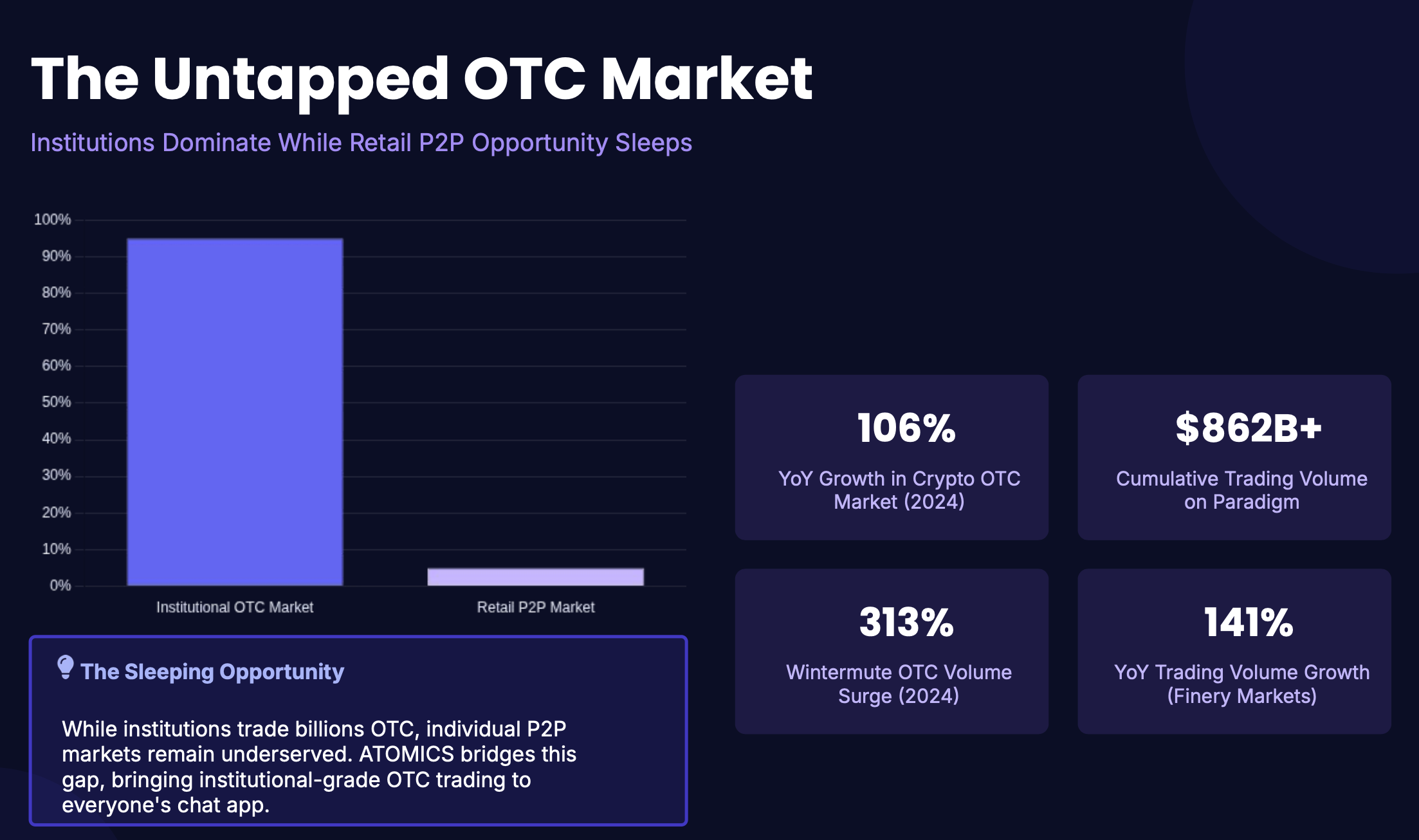
* Crypto OTC trading has seen significant growth industry-wide, with global OTC volume reported to exceed **$1,300+ billion per day** in some market analyses in 2025.
* Other industry data indicates that OTC market activity overall has been outpacing exchange growth, with year-over-year increases of over 100% in some metrics.
These aggregate figures underscore that **OTC liquidity is already a large and growing segment of the crypto markets**, even apart from Telegram.
#### The Reality of Telegram-Native Liquidity
Telegram has emerged as the de facto coordination layer for crypto OTC trading, particularly for:
* illiquid tokens and memecoins,
* early-stage or unlisted assets,
* NFT and NFT bundle trades,
* RWAs and off-chain-referenced assets,
* large block trades seeking minimal market impact.
In practice, thousands of Telegram groups facilitate daily bilateral and multilateral trades that never touch:
* AMMs,
* public order books,
* or formal OTC desks.
This liquidity is:
* real, recurring, relationship-driven, and price-discovered through negotiation rather than algorithms.
However, it operates almost entirely **outside cryptographic enforcement frameworks**.
#### Structural Reasons This Liquidity Is Missed
Most DeFi protocols implicitly assume that liquidity must be:
* pooled on-chain,
* visible in public order books,
* or mediated by smart contract-based matching engines.
This assumption fails in OTC contexts for several reasons:
1. **AMMs Are Structurally Incompatible with OTC Liquidity**\
AMMs require liquidity providers to lock capital into pools, which is economically inefficient for:
* large holders,
* illiquid assets,
* bespoke deal structures.
2. **Public Order Books Destroy OTC Price Discovery**\
OTC trading relies on private negotiation and contextual valuation. Public order books expose intent, invite front-running, and eliminate discretion.
3. **Bridges and Wrappers Introduce Custodial Risk**\
Telegram traders overwhelmingly prefer native assets. Wrapped representations and bridges introduce systemic risk that OTC participants actively avoid.
4. **Trust-Based Escrow Does Not Scale**\
Most Telegram OTC trades rely on:
* informal escrow agents,
* reputation-based enforcement,
* or outright trust between parties.
This approach limits trade size, excludes new participants, and creates latent counterparty risk.
As a result, **Telegram liquidity remains economically significant but structurally underutilized** by formal protocols.
#### Consequences of Ignoring Telegram Liquidity
Because this liquidity is not safely integrated:
* traders accept counterparty risk as a cost of participation,
* large trades are artificially capped,
* price discovery remains fragmented,
* and institutional capital cannot participate without centralized intermediaries.
This leads to a bifurcated market:
* **on-chain markets** that are transparent but shallow for illiquid assets,
* **off-chain Telegram markets** that are deep but unsafe.
The absence of a trustless bridge between these two worlds represents a major inefficiency in the crypto market structure.
#### How Atomic Swaps Address the Core Constraint
Atomic swaps directly solve the fundamental barrier preventing Telegram liquidity from being safely utilized: **lack of trustless settlement**.
By enforcing all-or-nothing execution via HTLCs, atomic swaps allow:
* bilateral OTC negotiation to remain social and flexible,
* while settlement becomes cryptographic and deterministic.
Importantly, atomic swaps do not require:
* pooled liquidity,
* public order books,
* or custodial intermediaries.
This makes them uniquely suited to Telegram-native OTC environments, where negotiation is human-driven and execution must remain private.
***
#### The Role of the ATOMICS Telegram Bot
The ATOMICS Telegram bot acts as a **protocol-native interface into this otherwise informal liquidity layer**.
Rather than attempting to replace Telegram communities, the bot:
* embeds structured trade intents into natural conversation flows,
* standardizes settlement parameters without constraining negotiation,
* and seamlessly transitions agreed-upon trades into atomic, on-chain execution.
The bot enables participants to:
* formalize deals that would otherwise rely on trust,
* execute large or complex trades without escrow,
* and access counterparties previously excluded due to risk.
Critically, the bot does not custody funds, enforce outcomes, or introduce new trust assumptions. It merely connects **social agreement** to **cryptographic settlement**.
***
#### Unlocking a Latent Market
By combining:
* Telegram-native coordination,
* atomic swap settlement,
* and chain-agnostic execution,
ATOMICS unlocks a large, latent market that previously operated in parallel to DeFi rather than within it.
This market includes:
* long-tail assets ignored by AMMs,
* relationship-driven OTC liquidity,
* and traders who prioritize discretion over automation.
By tapping into this liquidity, ATOMICS does not compete with existing DEXs—it **extends the reachable market boundary of decentralized trading**.
---
# Agent Instructions
This documentation is published with GitBook. GitBook is the documentation platform designed so that both humans and AI agents can read, navigate, and reason over technical content effectively. Learn more at gitbook.com.
## Querying This Documentation
If you need additional information that is not directly available in this page, you can query the documentation dynamically by asking a question.
Perform an HTTP GET request on the current page URL with the `ask` query parameter, and the optional `goal` query parameter:
```
GET https://atomics.gitbook.io/atomics/welcome-to-atomics/readme/problem-statement/untapped-telegram-otc-liquidity.md?ask=&goal=
```
`ask` is the immediate question: it should be specific, self-contained, and written in natural language.
`goal` is optional and describes the broader end goal you are ultimately trying to accomplish on behalf of the user. GitBook uses it to tailor the answer towards what is most useful for that goal.
The response will contain a direct answer to the question and relevant excerpts and sources from the documentation.
Use this mechanism when the answer is not explicitly present in the current page, you need clarification or additional context, or you want to retrieve related documentation sections.